Brief Introduction to Dome Projection
As the name suggests, dome projection refers to projecting images onto a spherical surface. It is an emerging display technology that breaks the limitations of
traditional projection on regular flat surfaces, enabling the creation of dreamlike visuals on the spherical screen. By leveraging projection blending technology
on curved surfaces, dome projection delivers a full - spherical panoramic image, offering audiences an entirely new visual experience. Viewers can enjoy
the projected content in a 360 - degree all - round way, providing an excellent presentation platform for things that can be better
showcased on a spherical surface.
Two Major Projection Methods of Dome Projection
Dome projection is divided into two types based on the location of the projectors:
one is the Internal Projection Sphere, and the other is the External Projection Sphere.
Internal Projection Sphere: The internal projection sphere places the projector at the bottom or inside the dome screen. It must also be equipped with
an ultra - wide viewing angle fisheye lens to project images onto the dome screen via reflection for imaging. Through the combination of a specialized
dome screen and the projector, this dome projection method forms an integrated image on the surface of the dome screen. It also supports multiple
images and multi - view windows to display projected content—including pictures, texts, videos, and more—delivering a stunning visual effect.
Standard Sizes: Diameter 60 cm, 80 cm, 1 m, 1.2 m, 1.5 m, 2 m, 2.5 - 5 m
External Projection Sphere: The external projection sphere utilizes four projectors to project onto the dome screen from four external directions.
By virtue of edge blending technology, it presents a seamless and realistic spherical image, while ensuring no image distortion, clear picture quality and vivid colors.
Standard Sizes: Diameter 1 m - 10 m
The Principle of Dome Projection
Different projection methods correspond to different working principles.
Principle of Internal Projection Sphere: Internal projection technology adopts fisheye projection to cast images onto the spherical screen.
There are usually two projection modes: one is orthographic fisheye projection, which causes stretching at the zenith and compression at the equator;
the other is equidistant fisheye projection, enabling uniform distribution of pixels on the spherical surface.
Principle of External Projection Sphere: External projection realizes imaging by using four external projectors to cast light onto the dome screen from four directions.
Through the edge blending system, the projected content from the four projectors is seamlessly stitched together, maintaining clear image quality and soft colors while ensuring no distortion.
Features of Dome Projection
-
-
-
-
-
-
-
-
-
-
-
-
-
-
-
360-degree panoramic viewing
-
High technical difficulty
-
Advanced technology content
-
Human-computer interaction
-
Customized demand
Advantages of Dome Projection
Advantages of Internal Sphere Projection
-
-
-
-
-
-
-
-
-
-
-
-
-
-
- High Cost-Effectiveness: Only a single projector is required for display, offering a relatively high cost-performance ratio.
- No Venue Restrictions: It can be set up anywhere as long as a sphere with a diameter greater than 1.5 meters is available.
- Simple Operation: Technicians can complete the installation and debugging within a single workday.
Advantages of External Sphere Projection
-
-
-
-
-
-
-
-
-
-
-
-
-
-
- 360° Viewing Angle: Provides a complete spherical viewing perspective.
- High Durability: Resistant to impacts and external forces.
- Specialized Material: Made of waterproof, moisture-resistant, and mold-proof resin.
- Easy Installation: Simple to install in any environment with minimal space.
- Superior Image Quality: Delivers exceptionally clear and precise visual output.
The internal projection sphere can be installed on walls, floors, or suspended in the air, and can be operated in conjunction with computers or projectors.
The larger the sphere, the more intuitive the presentation of objects. Its base configuration allows for installation in conference rooms, museums, or exhibition halls.
The external projection sphere can be installed either by ceiling suspension or fixed with brackets. It can be operated normally when paired with computers or projectors.
Operating temperature (℃): 0-40
Operating humidity: 0-100%
Dome projection equipment
| Software |
Hardware |
| Multimedia Computing System |
Projectors |
| Multi-Screen Projection Fusion System |
Spherical Projection Screen |
| Multi-Channel Playback Software |
Central Control Host |
| Stereoscopic Projection Software |
Fisheye Lens |
| Human-Computer Interaction Application System (Optional) |
Spherical Base Platform |
| Audio Effect System |
Sound System |
| Spherical Projection Content Production System |
An internal projection sphere only requires one projector and has relatively low requirements for the venue, needing only a space 1.5 times the size of the spherical screen;
an external projection sphere, however, requires multiple projectors and has relatively higher requirements for the venue.
Dome projection quotation
Regarding the quotation for spherical screen projection, we are unable to provide an exact figure, mainly due to the numerous influencing factors involved. Each item is determined
based on the customer's specific requirements, with an approximate price range of 150,000 - 500,000 RMB (including a 3 - 5 - minute video). For detailed quotations,
please feel free to contact us. Below is an overview of the price ranges for each piece of equipment.
Projectors: from RMB45000/pc to RMB180000/pc.
Dome Projection Screen: from RMB85000/pc to RMB350000/pc.
Dome Projection Lens: from RMB15000/pc to RMB30000/pc.
Graphics Workstation: from RMB5000/pc to RMB15000/pc.
Touch Screen: from RMB3000/pc to RMB4000/pc.
Spherical Screen & Equipment Bracket: from RMB10000/pc to RMB30000/pc.
Playback Software: from RMB5000/pc to RMB20000/pc.
Blending Software: from RMB4000/pc to RMB10000/pc.
Dome Overlay Software: from RMB2000/pc to RMB5000/pc.
Dome projection effect drawing
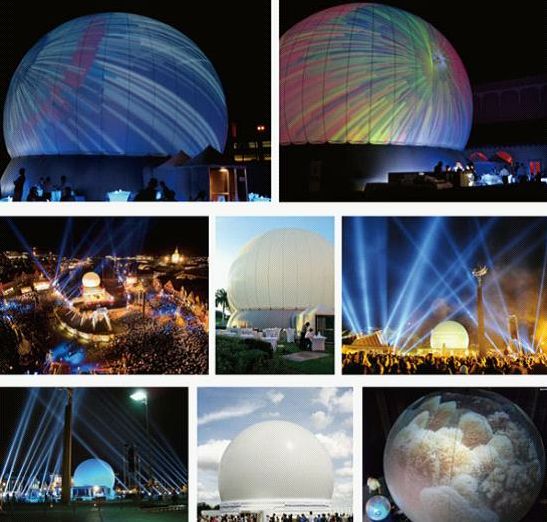
Internal Spherical Projection Effect Images
External Spherical Projection Effect Images
Common Presentation Formats of Dome Projection:
-
-
-
-
-
-
-
-
-
-
-
-
-
-
- 720° Spherical Dome Theater (Full-Spherical Type)
- ≥360° Dome Cinema (Semi-Spherical Type)
- Greater-than-Hemisphere Dome Theater
- Less-than-Hemisphere Dome Theater
- Full Hemispherical Dome Theater
- Virtual Flight Simulator Dome Theater
- An Irregular Bowl-Shaped Dome Theater refers to a bowl-shaped structure
- Hyperboloid Structure Dome Theater
The application fields of dome projection
1. Venues such as science museums, observatories, seismological bureaus, space agencies, schools, museums, and exhibition halls utilize animations and
images to present educational content on topics including the Earth, satellites, planets, earthquakes, oceans, the atmosphere, and the Sun.
2. In venues such as corporate exhibition halls, government exhibition spaces, cinema chains, entertainment venues, clubs, bars, KTVs, premium business
lounges, and tourist attractions, this technology can achieve exceptional brand exposure and promotional impact.
3. All user-required display content can be presented as needed.
The development trend of dome projection
With the continuous advancement of technology and breakthroughs in projection techniques, dome projection now offers a level of visual immersion and impact surpassing
other projection formats. It is highly suitable for display environments such as science museums, schools, and museums, and proves particularly beneficial
for teaching subjects like geography, oceanography, and astronomy. Therefore, in the future landscape of projection technology,
dome projection is poised to enter a phase of vigorous development.
What Is a Dome Cinema?
The dome cinema is a type of large-screen cinema that emerged at the end of the 20th century. Commonly also known as "dome film theater", it adopts fisheye lenses for filming and projection.
The audience is entirely located in a domed theater, where the screen—mainly a semi-spherical one—encloses the audience on three sides. Dome cinemas feature sharp image quality,
with the visual effect extending beyond the viewers' field of vision to their rear. Additionally, the venues are equipped with 3D surround sound, delivering an extremely powerful on-site experience.
Its immersive impact far surpasses that of circular screen projection and giant screen projection, making it increasingly widely adopted.


